Leadership, Strategy
30 Jan 2023

Strategic talent development develops capabilities to achieve future competitive advantage

Strategic talent development develops capabilities to achieve future competitive advantage

As the talent shortage grows, competing for the best talent is no longer enough. To succeed in the future, organisations must make efforts to ensure they have the best talent. It is essential to identify the capabilities and competences that will give organisations a competitive advantage, and how these capabilities will be put into practice and developed.


In 2022, we published a strategic renewal study report in which we asked the management of listed Finnish companies what factors help them innovate and what capabilities and competencies are needed in the future. The need for competence renewal has been identified, but a more explicit focus and roadmap are still required. This topic has triggered a lively debate among our clients' management on the future skills needs and how to lead the development of these skills.

In this article I highlight three critical points for senior management in organisations in managing future competencies:

1. Identifying strategic capabilities and competencies as part of the strategy work

Understanding what capability and competence mean for the organisation to lead future competencies is essential.

Capability is a broader concept than competence. Strategic capability is the ability of an organisation to use its resources (e.g. financial resources, means of production, partnerships, processes, brand, culture) in a way that realises its long-term vision and delivers competitive advantage in the future. Capability requires competence, which refers to the attributes, knowledge and skills of individuals and teams that can be developed.

Today, competitive advantage is increasingly achieved in a unique value-creating ecosystem. The ability to operate in such an ecosystem or value network requires a wide range of shared skills and activities, such as the ability to identify and lead the potential of networks, build trust, co-learn, and a wide range of contractual and collaborative skills. Once these competencies are broken down into concrete skills, they can be led systematically in a way that is easy to communicate to staff.

The development of competencies should be more than just a side note in the annual report. Identifying strategic capabilities and competencies should be an organic part of the strategy work. This requires extensive cooperation between management, HR and key personnel and a shared understanding of the competencies that will give the company a competitive advantage in the future. Strategy implementation is about building these capabilities.
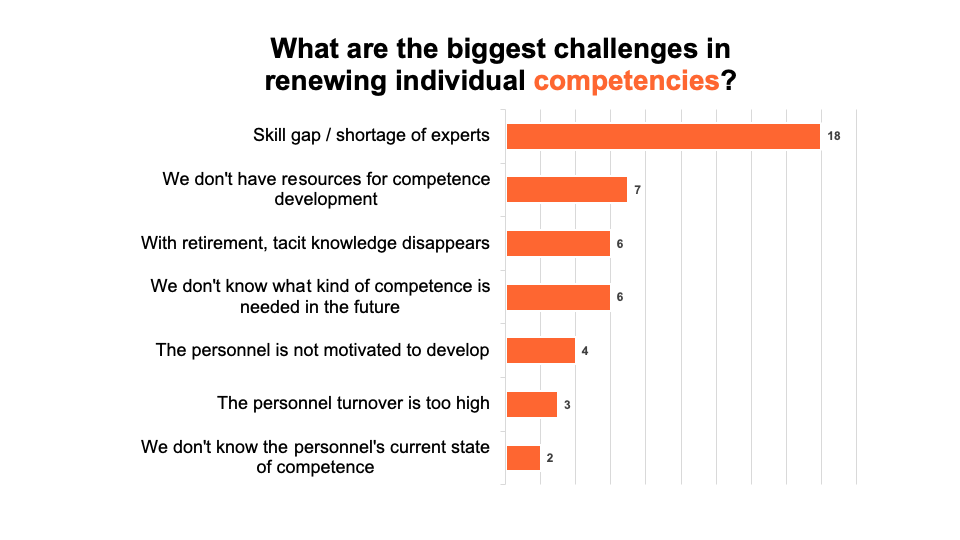
Biggest challenges in renewing competencies

"Strategic talent development is the development of the capabilities and competencies that gives an organisation a competitive advantage. It is successful when talent management and development is high on the business agenda and sponsored by the organisation's top management."

In 2022, we published a strategic renewal study report in which we asked the management of listed Finnish companies what factors help them innovate and what capabilities and competencies are needed in the future. The need for competence renewal has been identified, but a more explicit focus and roadmap are still required. This topic has triggered a lively debate among our clients' management on the future skills needs and how to lead the development of these skills.

In this article I highlight three critical points for senior management in organisations in managing future competencies:

1. Identifying strategic capabilities and competencies as part of the strategy work

Understanding what capability and competence mean for the organisation to lead future competencies is essential.

Capability is a broader concept than competence. Strategic capability is the ability of an organisation to use its resources (e.g. financial resources, means of production, partnerships, processes, brand, culture) in a way that realises its long-term vision and delivers competitive advantage in the future. Capability requires competence, which refers to the attributes, knowledge and skills of individuals and teams that can be developed.

Today, competitive advantage is increasingly achieved in a unique value-creating ecosystem. The ability to operate in such an ecosystem or value network requires a wide range of shared skills and activities, such as the ability to identify and lead the potential of networks, build trust, co-learn, and a wide range of contractual and collaborative skills. Once these competencies are broken down into concrete skills, they can be led systematically in a way that is easy to communicate to staff.

The development of competencies should be more than just a side note in the annual report. Identifying strategic capabilities and competencies should be an organic part of the strategy work. This requires extensive cooperation between management, HR and key personnel and a shared understanding of the competencies that will give the company a competitive advantage in the future. Strategy implementation is about building these capabilities.

Biggest challenges in renewing competencies

"Strategic talent development is the development of the capabilities and competencies that gives an organisation a competitive advantage. It is successful when talent management and development is high on the business agenda and sponsored by the organisation's top management."

In 2022, we published a strategic renewal study report in which we asked the management of listed Finnish companies what factors help them innovate and what capabilities and competencies are needed in the future. The need for competence renewal has been identified, but a more explicit focus and roadmap are still required. This topic has triggered a lively debate among our clients' management on the future skills needs and how to lead the development of these skills.

In this article I highlight three critical points for senior management in organisations in managing future competencies:

1. Identifying strategic capabilities and competencies as part of the strategy work

Understanding what capability and competence mean for the organisation to lead future competencies is essential.

Capability is a broader concept than competence. Strategic capability is the ability of an organisation to use its resources (e.g. financial resources, means of production, partnerships, processes, brand, culture) in a way that realises its long-term vision and delivers competitive advantage in the future. Capability requires competence, which refers to the attributes, knowledge and skills of individuals and teams that can be developed.

Today, competitive advantage is increasingly achieved in a unique value-creating ecosystem. The ability to operate in such an ecosystem or value network requires a wide range of shared skills and activities, such as the ability to identify and lead the potential of networks, build trust, co-learn, and a wide range of contractual and collaborative skills. Once these competencies are broken down into concrete skills, they can be led systematically in a way that is easy to communicate to staff.

The development of competencies should be more than just a side note in the annual report. Identifying strategic capabilities and competencies should be an organic part of the strategy work. This requires extensive cooperation between management, HR and key personnel and a shared understanding of the competencies that will give the company a competitive advantage in the future. Strategy implementation is about building these capabilities.

Biggest challenges in renewing competencies

"Strategic talent development is the development of the capabilities and competencies that gives an organisation a competitive advantage. It is successful when talent management and development is high on the business agenda and sponsored by the organisation's top management."

In 2022, we published a strategic renewal study report in which we asked the management of listed Finnish companies what factors help them innovate and what capabilities and competencies are needed in the future. The need for competence renewal has been identified, but a more explicit focus and roadmap are still required. This topic has triggered a lively debate among our clients' management on the future skills needs and how to lead the development of these skills.

In this article I highlight three critical points for senior management in organisations in managing future competencies:

1. Identifying strategic capabilities and competencies as part of the strategy work

Understanding what capability and competence mean for the organisation to lead future competencies is essential.

Capability is a broader concept than competence. Strategic capability is the ability of an organisation to use its resources (e.g. financial resources, means of production, partnerships, processes, brand, culture) in a way that realises its long-term vision and delivers competitive advantage in the future. Capability requires competence, which refers to the attributes, knowledge and skills of individuals and teams that can be developed.

Today, competitive advantage is increasingly achieved in a unique value-creating ecosystem. The ability to operate in such an ecosystem or value network requires a wide range of shared skills and activities, such as the ability to identify and lead the potential of networks, build trust, co-learn, and a wide range of contractual and collaborative skills. Once these competencies are broken down into concrete skills, they can be led systematically in a way that is easy to communicate to staff.

The development of competencies should be more than just a side note in the annual report. Identifying strategic capabilities and competencies should be an organic part of the strategy work. This requires extensive cooperation between management, HR and key personnel and a shared understanding of the competencies that will give the company a competitive advantage in the future. Strategy implementation is about building these capabilities.

Biggest challenges in renewing competencies

"Strategic talent development is the development of the capabilities and competencies that gives an organisation a competitive advantage. It is successful when talent management and development is high on the business agenda and sponsored by the organisation's top management."

In 2022, we published a strategic renewal study report in which we asked the management of listed Finnish companies what factors help them innovate and what capabilities and competencies are needed in the future. The need for competence renewal has been identified, but a more explicit focus and roadmap are still required. This topic has triggered a lively debate among our clients' management on the future skills needs and how to lead the development of these skills.

In this article I highlight three critical points for senior management in organisations in managing future competencies:

1. Identifying strategic capabilities and competencies as part of the strategy work

Understanding what capability and competence mean for the organisation to lead future competencies is essential.

Capability is a broader concept than competence. Strategic capability is the ability of an organisation to use its resources (e.g. financial resources, means of production, partnerships, processes, brand, culture) in a way that realises its long-term vision and delivers competitive advantage in the future. Capability requires competence, which refers to the attributes, knowledge and skills of individuals and teams that can be developed.

Today, competitive advantage is increasingly achieved in a unique value-creating ecosystem. The ability to operate in such an ecosystem or value network requires a wide range of shared skills and activities, such as the ability to identify and lead the potential of networks, build trust, co-learn, and a wide range of contractual and collaborative skills. Once these competencies are broken down into concrete skills, they can be led systematically in a way that is easy to communicate to staff.

The development of competencies should be more than just a side note in the annual report. Identifying strategic capabilities and competencies should be an organic part of the strategy work. This requires extensive cooperation between management, HR and key personnel and a shared understanding of the competencies that will give the company a competitive advantage in the future. Strategy implementation is about building these capabilities.

Biggest challenges in renewing competencies

"Strategic talent development is the development of the capabilities and competencies that gives an organisation a competitive advantage. It is successful when talent management and development is high on the business agenda and sponsored by the organisation's top management."

In 2022, we published a strategic renewal study report in which we asked the management of listed Finnish companies what factors help them innovate and what capabilities and competencies are needed in the future. The need for competence renewal has been identified, but a more explicit focus and roadmap are still required. This topic has triggered a lively debate among our clients' management on the future skills needs and how to lead the development of these skills.

In this article I highlight three critical points for senior management in organisations in managing future competencies:

1. Identifying strategic capabilities and competencies as part of the strategy work

Understanding what capability and competence mean for the organisation to lead future competencies is essential.

Capability is a broader concept than competence. Strategic capability is the ability of an organisation to use its resources (e.g. financial resources, means of production, partnerships, processes, brand, culture) in a way that realises its long-term vision and delivers competitive advantage in the future. Capability requires competence, which refers to the attributes, knowledge and skills of individuals and teams that can be developed.

Today, competitive advantage is increasingly achieved in a unique value-creating ecosystem. The ability to operate in such an ecosystem or value network requires a wide range of shared skills and activities, such as the ability to identify and lead the potential of networks, build trust, co-learn, and a wide range of contractual and collaborative skills. Once these competencies are broken down into concrete skills, they can be led systematically in a way that is easy to communicate to staff.

The development of competencies should be more than just a side note in the annual report. Identifying strategic capabilities and competencies should be an organic part of the strategy work. This requires extensive cooperation between management, HR and key personnel and a shared understanding of the competencies that will give the company a competitive advantage in the future. Strategy implementation is about building these capabilities.

Biggest challenges in renewing competencies

"Strategic talent development is the development of the capabilities and competencies that gives an organisation a competitive advantage. It is successful when talent management and development is high on the business agenda and sponsored by the organisation's top management."

About the author

Emilia Sainisalo (Ms.Soc.Sc, Social Psychology), Certified Business Coach (ACC), works at Hanken & SSE as an Account Director and executive coach. Emilia has extensive experience in Business HR and strategic HRD in global environments. She specialises in leadership, leadership team & culture development, leading competency, change leadership, solution design and individual business coaching.

Image for Emilia Sainisalo
Emilia Sainisalo
Growth Area Director, Career Renewal

Contact us for
more information

Image for Emilia Sainisalo
Emilia Sainisalo
Growth Area Director, Career Renewal
+358 45 677 8557 emilia.sainisalo(a)hankensse.fi
Share page